"Heroes of the Soil: The Champions of Regenerative Agriculture”#3
Alright No Lack Family,
I hope this finds you all blessed! As many of you know, the culture and values of regenerative agriculture are very important to me; and that was why I started the "Heroes of the Soil: Champions of Regenerative Agriculture” blog. I have set out to interview those in the trenches that are tasked to “hold the line” ecologically, if you will - those who are not content with the wayward direction that agriculture has been going over the last few decades.
Through this blog I want to highlight the unsung heroes that have set for themselves the lofty goal of leaving behind something for future generations that is better than what they inherited.
And so, I welcome you to come along with me on this journey through rural landscapes. Who knows, in the process you may learn something new about your neighbor or maybe meet a neighbor you never knew you had.
Today, it is my absolute pleasure to introduce you to Angie and Herrell Collins, owners and stewards of Trimbull Farm in Cullman, Alabama. I first met Angie and Harrell back in 2023 when I was searching for a new bull calf to become the sire for my herd. Little did I know that it was the beginning of a lasting friendship and over the last couple of years, I have purchased several head of cattle from them. I can attest personally that they are salt of the earth folks, with big hearts and a love for regenerative agriculture!
Without further hesitation, please welcome Angie Collins!
Herrell and yourself have a rich rural background. Can you kind of paint a picture for us, in your own words, of the road that led you here?
Sure, Herrell was raised on a farm with nearly 200 acres. They row cropped corn, soybeans, and wheat. He grew up with a flock of chickens, off and on they had cattle, and raised pigs. When his grandparents were still alive, the whole family got together for the fall butcher. Herrell had around 100 feeder pigs as a teenager. Herrell's grandfather was an overseer for a man that ran over 200 head of cattle. He grew up tagging along with him.
As for me, my family was self-employed. We had a Campground on Smith Lake and a storage facility. We had 16 acres on a dead-end road with no houses in sight. I have always been a huge animal lover. I grew up with a flock of chickens; they were my friends - dead end road, no houses in sight lol. We ate the eggs and once a year we thinned the flock down and put them in the freezer for food. (Dad always had me choose which ones, so we wouldn't eat my favorites). My father was a big outdoorsman. He taught me to fish, trap rabbits, squirrel and deer hunt. My dad and I butchered and cleaned everything we caught. Mom grew a big garden each year and we canned a LOT of food.
Herrell & I got married in 1989 and moved off his big family farm to a 2-acre lot. We both were not happy there. Neither of us liked looking at our neighbors across the street. So, we sold our house, bought a mobile home, and waited for a piece of land.
So, you guys have been farming and raising cattle since the early 90's. What did your operation look like back then and what got you started down the road to a more regenerative/sustainable model?
In 1990 we had cattle on leased land. A cow/calf operation. Our first daughter was born in 1991. I would put her in a backpack and would go check on the cows each day. Herrell was working 12hrs a day. In 1994 we bought 25 acres that we currently live on. Over the years we have had goats & cows on the property. The cows were raised just like everyone else did - put out on the whole pasture for the whole year. No sacrifice area at any time and wormed regularly. I think we even vaccinated at one point.
In 2011 God closed a door. The plant Herrell worked at shut down and he lost his town job. My dad was sick with cancer at the time. It was a very hard year, but God had a plan. A year later we bought my parents’ business, so in 2012 we became self-employed. This new job venture allowed Herrell to go to the sale barn in our off season because by this time the campground had moved away from overnight camping.
Herrell would buy what he thought he could turn around and make a profit on. Side bar: We had raised and shown dogs from 1997-2014. We actually were very successful at it. We were the breeders of 27 AKC Champion bulldogs and were inducted into The Hall of Fame. This was my job which I loved!!! Genetics and studying pedigrees. Trying to correct faults with each new breeding, raising puppies, and training them for the show ring. We kept 3 AKC Champion Studs and I was shipping puppies and semen all over the U.S. We were gone at least 2-3 weekends a month.
But, when Herrell lost his job. The dog show world came to a screeching halt... I tried to hang on to the dogs a year after we bought the campground. I thought we might swing it in the winter months. Then we had a grandchild coming. I was asked to babysit him. I had to give up something. God had a plan, and the dog show/breeder world door was closed. It was hard giving up on the dogs, but I made a decision, and I do not regret it.
Off and on over the years we had a garden and preserved food. With giving up the dogs I was able to go back to my roots and have had a garden every year since. When the grandkids started toddling around, laying hens were added back to the farm. We wound up having 5 grandkids in a 3-yr span, with a set of twins in the mix. It was (and still is) such a joy to include them in this farm life. Teach & Talk to them about how great God is and how cool the cycles are. (We have 7 grandkids now)!
Around 2021 I read an article on Dexter cattle. We were very intrigued. I guess it was God moving us into the path he wanted us. So, we sold the cows we had and bought Dexters. They were the coolest cows ever! These cows were so inquisitive. I could be doing whatever in the yard and I had all these cows coming up to the fence standing there like a dog watching what I was doing. Some of our cows came out of North Carolina, one of which was a milk cow. I had thought I wanted to milk a cow at some point. Maybe after I retired, but she just fell in my lap. With a milk cow came the milk. I think we had 4 grandkids at that point and the milk was used up quickly. I even had a jersey cow before they started going to school.
We calf share which means the calf is with the mom during the day and then separated overnight and you get the first milk in the morning. With the milk cow came a calf that needed to be halter broke. Then in my mind all the calves needed to be halter broken. The Dexters, along with all the other animals really have filled a void in me that I had been missing since getting out of the dogs.
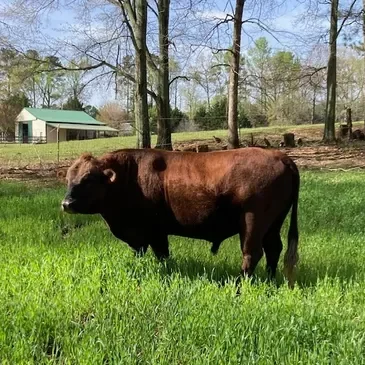
FIVE STAR ADAM ADCA # 036341
Out on pasture enjoying forage that is nearly knee high!
What changed you to a regenerative/sustainable farm?
2 things.
1)We put a deposit down on a registered bull calf fall of 2021. The farm we got him from was a regenerative farm. They rotationally grazed and she had a ton of grass left for the fall, which no one around us had. After seeing their farm, we started rotationally grazing and trying to start down the same path.
2) In 2022 my neighbor asked me to ride to Tennessee to the 2-day Homesteaders of America convention. This door was opened by God. We worked at our business, the Campground and Storage facility, on the weekends, so for me to leave during the summer on a weekend was HUGE because it was just Herrell and I, no employees. But this was the game changer for us.
I came home from hearing Daniel Salatin speak on Grazing 101. It was basically about rotational grazing and how it will build your soil and how to lay out our paddocks, water, etc. Joel Salatinn spoke on pasture laying hens, not confined in a hen house, meat rabbits, and so much more I can't remember. I came home with tons of notes, and photos I had taken of the slides and some books. What they said made tons of sense to me and we really stepped up implementing it on our farm.
How would you describe your core philosophy behind land stewardship and animal care? In other words, there are a lot of buzzwords in agriculture today so, what does "regenerative” mean to you?
We 100 percent feel like we are stewards of our farm and animals. To us “regenerative” is adding back not taking away, using what God has given us, a focus on improving the health of the land, growing soil fertility, trying to improve the genetics with every new generation of animals.
Is there a spiritual or personal conviction that drives your work?
Well, we both were raised to work, you might say we are workaholics! The Bible says, “if you don't work, you don't eat” God has opened and closed so many doors for us. Sometimes change is easy, other times, like (Herrell losing his job, the dogs going away) change is hard. We see it all now and feel he has placed us here, his plans were way better than ours, even though at the time we didn’t understand. I hate to sound cheesy, but we are here on this farm for a reason, possibly a season, we hope for a lifetime. We want to be good stewards of what we have been given and help others.
Can you walk us through a typical day on your farm?
We were able to retire this year. We sold the business this past Feb. So, all our time is spent here on the farm. We also were able to purchase 28 more acres about a 1/4mile down the road. It had been a cattle farm but had not had cows on it or been mowed for 4 or 5 yrs. The land was going back to the woods. Some trails and washes had gotten too big; they were 6ft wide and taller than your head. You could not even drive across it, and it was super hard to walk through it.
Parts of it were so grown-up you couldn't see what was in front of you. We had a dozer come in and grade the washes, and when he left Herrell took the skid steer and drove around first to make sure he didn't fall in an unseen ditch (which he did). Then he brush hogged it, and some of it was taller than his tractor cab. We've worked all summer and fall, we've put up new fences and found a natural spring that Herrell converted to a pond. We just moved the cows up there this past month. It is such an exciting time for us!
Two things happen daily here.
1)With both of us it starts with Morning Bible time, devotions and prayer. Herrell starts with a whole POT of coffee first thing. Depending on who I have in milk and how early I get up it may be before or after I milk the cow but always seeking God first thing. We keep our grandkids when they are not in school 3 days a week and every other week 3 of them (ages 6-8) have a sleep over with us. Bible time always includes them when they are here. I watched my grandfather read his Bible 3 times a day. I've never met another person who was so focused on God and we want to instill that within our grandchildren.
2)The day ends sitting with the cows, this is the time of day when we talk about our day and enjoy them. Most days I go out with the cows, give them lots of scratches, there may be some cookies involved (smile) and watch the sunset.
In the mornings Herrell is up and out checking the cows. Daily chores include tasks like fencing. In fact, this past week we ran 1100 ft of water line across the new property. There is a well we will be hooking up next week and building a well house for. He ran the pipe so we could gravity feed out of the original pond but we also have a cut off valve installed to switch the water to a well so we can push it up the hill. And we have water faucets to put in. Once or twice a week, we set up new paddocks for the cows. We've torn down a section of fence on the back of the property here at the house where we will be putting new fencing back up and Herrell has been trying to fix some drainage issues before the winter rains set in. We watched a guy pull a big chain deep into the ground with a sub soiler multiple times to drain where water stands. And we plan on trying this because we have several low places, and we hope this helps.
I garden year-round and have a greenhouse. But even without it I am continually growing with the help of low tunnels, (frost cloth) and in the summer I probably work in the garden 3+ hrs. a day. We eat a lot of our produce fresh, but I also preserve a portion of it by water bath canning, freezing, pressure canning, fermenting and freeze-drying.
Since “retirement” things are slower now but there is always something to do! I'm finishing up with my tomatoes; I harvested broccoli and cauliflower yesterday. Earlier this week we had roasted carrots, daikon radish, fresh from the garden along with onions and bell pepper I grew. This past week I cut up a milk crate of onions that I harvested in the summer and had stored in a cool room, because some were starting to sprout. Part of the onions I cut up and froze for the freezer. I placed 5 trays in the freeze dryer; I have them all packaged up and canned 5 quarts of French onion soup too. I also dry-canned 10 quarts of potatoes last week. I plan to seed several plants as well as onions out in the garden that I grew from seed next week. Always the garden with me….
We also have TAMUK rabbits. The homestead conference I attended in 2022 had meat rabbits and we started raising them shortly after. My neighbor had rabbits and wanted to get more hands-on experience with butchering them, so we did it together. As I said before, I grew up trapping rabbits. (I even took some with me from the freezer when we got married).
If you butchered it, you could bring it home with you. That was the rule! I had never eaten a tame rabbit before, so this was a first for me. It is not like a wild rabbit at all. In fact, if you were told you were eating chicken, you would not know you were not eating chicken. They are way easier and quicker to butcher than a chicken as well.
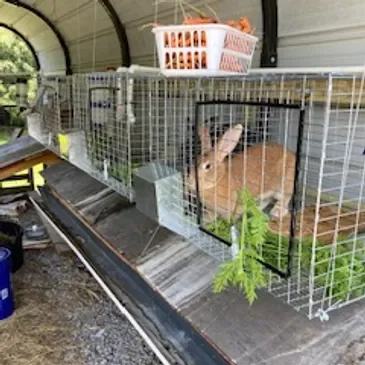
TAMUK Rabbits
Enjoying fresh carrots and greens in the Rakin house.
From birth to 12 weeks, I can have a 3 1/2lb rabbit. TAMUK are meat rabbits that were bred by Texas A&M to be heat tolerant. I have 3 does ready to give birth this weekend. They are in what is called a raken house. It's a big house and if I was guessing 16x40 ft and the rabbits are in large crates and chickens are underneath on an 18-inch bed of deep litter. The chickens till up the shavings and in about a 2-year timeframe you have this great compost that can be used in the garden or put on pasture. Rabbit manure is not hot so I can use it immediately in the garden. In the future, I would like to experiment with rabbits being tractored out on pasture.
We also have laying hens and we sell our eggs via a roadside egg hut. They have access to pasture and can come into this Raken house via a small door in the heat of the summer. They like it inside there, when it's hot because it stays pretty cool. The hen’s also escape to the raken house when the rain comes! This time of year, with the grass not green, they are spending a lot of time in it as well. I've been giving them the remains of my garden waste, mostly plants that died off from the freeze we had a couple of weeks ago. Both bunnies and chickens are getting carrot tops, broccoli leaves, and greens from the garden.
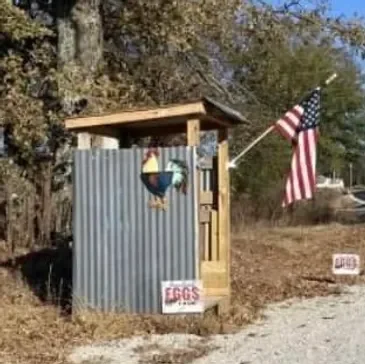
Roadside “Egg hut”
Our summers are filled with grandkids, and we love being able to share the farm with them. It is such a good teaching tool for everything! How cool God is in how he has laid everything out, the ecosystem in full play. I hate that we missed this with our kids, but the grandkids are gathering eggs, feeding rabbits, cleaning pens, petting haltered calves and they all love that I milk a cow, and a few have tried to milk the cow, but they are at a silly age and are kinda geeked out about it. But they love making homemade butter, cheese and ice cream, watching broody hens playing with baby chicks, helping me start seeds, plant plants, pick berries and vegetables, making fresh cobblers, and canning jelly. They will tell you straight up home grown is better than store bought! Nearly all can drive a buggy (U.T.V.) and help us set up paddocks, it’s hot work but good for them. And of course, we do play and do non-farm stuff too.
We disease test our cattle for BVD, Johnes, and BLV. And with my experience of drawing blood from the years with the dogs, I have jumped right in, and we do it ourselves. We also run the Neogen Beef panel on all our cows. This test helps you determine the average birthweight of calf they will throw, stay-ability on your farm, milk production, hanging carcass weight, fat, tenderness, and ribeye circumference. I love being able to see this and it is giving us a tool to use to improve our herd genetics. I love the details and can easily spend hours looking over the reports!
How do you manage pasture rotation and soil health?
In the summer we rotate the cattle to a new paddock every day. And with the spring flush we can't keep up and will have to clip the seed tops. We try to graze a 1/3rd, leave a 1/3rd and letting them trample a 1/3rd. By letting them trample this 1/3rd it helps build soil and organic matter which allows rainfall to infiltrate and be held longer by the soil, reducing run off. Practicing this allows your pastures to be a better solar collector, resulting in faster regrowth, a better root system, and improved drought tolerance. We have some bare spots that we are trying to cover, but that is a work in progress.
In the fall of 2024, we added 2 tons per acre of lime and this year we used organic fertilizer from Texas Pasture Plus in the form of a foliar spray. It is a high-performance fertilizer that is designed to rejuvenate soil health and boost microbial richness. The ingredients are molasses, fermented chicken litter, fish emulsion, liquid seaweed, and kelp; and it contains over 750 strains of microbes. It works by building the soil from underneath.
In the spring we plant a mix of summer grazer, Sunn hemp (which is a nitrogen builder) and sorghum Sudan grass with a few more things thrown in. This easily gets over 4ft tall and they love it. We don't do the whole farm but have at least 5 acres over seeded with this. And we have done the same thing with wheat or rye for cool weather grazing.
In 2024 we added a free choice mineral program, it has 18 or so different minerals in it that the cattle can choose from. We hook it to the buggy, and it is rotated to each paddock, moving with the cattle. And it is multi purposed. If the grass is lacking in any nutrients the cattle need, they will get it from this mineral feeder and then they are also passing the nutrients back to the soil via urine and waste, thus regenerating the soil. This spring we got a ton of rain, the grass was growing like crazy, and they were eating a ton of minerals. I called the company to reorder; but I didn't know how to predict what to buy. It took a day for them to respond but they finally had their guy call me. He took the time to educate me and let me know that although we were pumped about all this grass, because it was growing so fast it was not as nutrient dense as one might think.
How do you handle challenges like drought, parasites, or winter feed planning?
We've had quite a few droughts since getting the Dexters. Planting of summer annual forage does help with drought. We attended a grazing school, and the instructor had dug up 3 or 4 (5) gallon buckets of forage to illustrate how the height of the forage above ground mirrored the root systems. If your grass is 4 inches tall you will have 4 inches of roots, if your grass is 8 inches tall you have 8 inches of roots etc. When you take forage from 12 inches to 4 inches the roots die down to 4 inches. So, the taller the forage the deeper the roots, and the deeper the roots the more likely it is that they can survive a drought. A 4-inch forage most likely cant. When you get rain, your forage will put back out but if you let the cattle eat it off to the ground it is way harder for the forage to come back. My rule of thumb is “If you can see your cows hoofs you have grazed too close.”
We have used sacrifice paddocks for drought just like you use in the winter. In those cases, we take them off the pasture and go to feeding hay. We have had droughts where there is no green left. We don't let them continue grazing it. When it does rain the forage comes back and we start grazing again. I did read an article in the Stockman Grass Farmer this summer about Serengeti grazing during droughts. We may give it a try but hope we never have to!
On the topic of parasites, if your animals are not eating off the ground they won’t get worms. Since we started rotational grazing and giving free-choice minerals our cows don’t get parasites like they would otherwise.
With winter feed planning, we have done several things. We plant some forage. In our zone if you plan to stockpile forage for the winter you need to stop grazing around the first of August. We have planted a winter grazer mix on some acres of our pasture, like we do in the summer grazer.
We have had years where we did the sacrifice lots only and fed hay in rings up near the house. They beat it down and it can become a big muddy lot from winter and spring rains. If you choose to do this, we have found a grass species called red river crabgrass. We get it from Petcher seeds. They have a mix with sun hemp. It will be up and going hard in 45 days and works amazingly!!!
We have let them hit the pasture fescue and or winter grazer and bring them back to the hay rings at the house.
Last winter we rolled out hay, which is an excellent choice. You will build soil with the hay they leave behind, and you get the benefit of the grass seeds. We actually bought a Greg Judy hay unroller last year that we can pull behind the U.T.V. That works out great because you don't have the weight of the tractor rutting up the ground.
This year on the new farm the forage is very tall, and the fescue is going strong. It will be late December before we have to do anything up there other than graze. I have 6 heifers that are due in January so they will be coming back here, and we will unroll hay on some weak spots.
I've been hearing about a bale grazing technique where you take a poor area and grid it off with poly-rope and put the bales out there. We have a section that we took from woods to pasture. It is on a hill and there is hardly any topsoil on it. We rolled out hay on it last year and it is much better, but it has a long way to go. We may make it our sacrifice area this year.
That’s a great segway into my next question! What changes have you seen in your land since adopting regenerative practices?
Well, we definitely have thicker, more plush pastures. We have been able to capture more carbon; more litter under the grass. We have more types of grass than we have ever seen before. I've added the “picture this” app to my phone so I can identify them all, Lol! - brome for one, also, we have had a ton orchard grass and perennial rye that is moving across the farm. The most exciting thing this summer was when I walked up to a huge (bigger than the end digit of my thumb) dung beetle going to town on a fresh cow pie. Lol, I'm the crazy old farm lady out there taking video of the beetle and sending it to all my farm friends. The norm for years was the cow pie just laid there, or if you flipped them over there were just fire ants, no worms. We are now seeing worms!
We still have a long way to go, but it is all coming together and we are definitely seeing progress. Herrell helped a friend bale hay this summer and he has a lot of cows but doesn’t farm the way we do. He asked Herrell when we were able to start grazing. He was surprised when he told him that we were back out in March, because he said it was sometime in May before he was able to quit feeding hay.
What does grass-fed, grass-finished look like in practice—seasonally and nutritionally?
Grass fed, grass finished, by my definition, is that they only ate forage all their lives. And when you do that, the meat contains healthier fats and has more nutritional value than steers that have been pumped full of grain most of their lives.
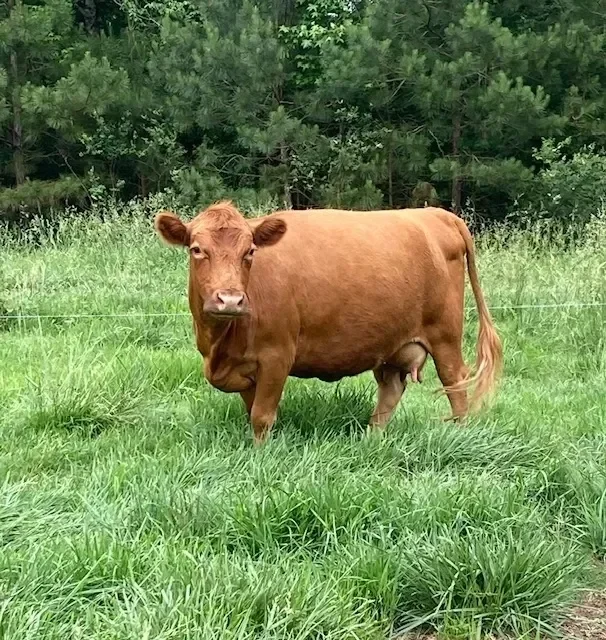
Dexter Cow out on lush green pasture.
How do you communicate the value of your beef to customers who may not understand regenerative agriculture?
To be honest we have just self-butchered or taken to the butcher. But with the addition of our new acreage, we have kept back 3 steers this year to start adding the sale of beef to our farm and plan on keeping more each year. In the past we felt we didn’t have enough forage, but we have felt the call from God to head in this direction. We feel people are really becoming aware of the food system we currently have fallen into and are wanting to reconnect with a more natural food supply. We have already gained interest from neighbors and former (campground) customers!
It is becoming widely known that grass finished beef contains healthier fats and more nutrients than grain finished. There are also studies (but you won’t find them on google) that have been ran, that show that the more diversity you have in your pasture, will lead to more tender beef. An example of this would be pastures that have been sprayed for weeds versus a pasture that has not. Both sprayed and unsprayed have grass but there is a difference. Case in point, there is plenty of vegetation that is considered inferior but actually has great nutritional value. I’ll give you a great example, we moved the cows up to the new farm recently, within the last month, and there was a lot of goldenrod and Johnson grass. And in some spots the Johnson grass was taller than their heads. Of course they went to the more tender grasses first. But next they stripped all the leaves off the goldenrod and ate the Johnson grass like it was candy! We had some people hint at the pasture looking rough, but to us, we were tickled to death with it! When you look it up, you find out that there is a benefit to the cattle eating this forage and it is amazing. You have just as much protein, healthy carbs and fiber as what is considered good forage for cows, but as in the case with the goldenrod, it has medicinal properties like being an anti-inflammatory and diuretic.
How do you mentor or support other farmers interested in regenerative practices?
Mostly over the phone. When people call about our Dexters that are for sale, we normally ask if they currently rotationally graze and explain the benefit of using one strand of poly-braid wire to move them back and forth across the pasture and the difference they will begin to see. We also welcome them if they are ever in the area to come by and tour our farm.
I've also taught a few skill classes at local homesteading ladies group meetings; like seed starting. One method I teach is called “milk jug seed starting” and you can get most seeds to germinate using this method without all the fancy equipment. I also teach others about container gardening to encourage them to grow their own food even if they don’t have room for a garden. I’m big on just starting with one thing and then adding to it as you go. The key is to start, because the food you are buying at the store is being sprayed with something, and you know it is not good for you.
I've taught rabbit butchering. I had some friends over a couple of weeks ago that had never pressure canned and we canned beef stew. There are a ton of people moving here from out of state and I think people are just becoming more aware of the current state of the food system. So, they are eager to learn these skills. These are things that are being lost and forgotten. We have a new neighbor that has moved in from Texas that has never farmed in any capacity. So, we helped them set up their rotational grazing system and set up an easy solar system to pump water from their pond to water their cows and I am currently teaching her to halter her calf.
Bonus question: What kind of legacy do you hope to leave as it pertains to your land, your animals, and your community?
Land: We are striving to leave the land better than we found it. We have seen so much change in the land in the last few years, and we can’t wait to see what it looks like in the coming years.
As for the animals: to produce a better quality and more natural life for them. God has blessed us with this land and tools to help in this. We can’t wait to see what direction He leads and what doors he opens or might close.
Community: I shared a few notes we have received from egg customers to a friend. She told me, “y’all have your own ministry just in providing eggs for your community.”
We would like to continue to serve our community and help mentor others in farming and if they wish, help teach them to grow and preserve their own food to create a more resilient, self-sufficient lifestyle. We have 7 grandkids; these are skills we can pass to them. Who knows there might be a future generation….
Guys, I really appreciated the time that Angie spent giving us a peek into the day to day at Trimbull Farm! I always come away from one of these interviews learning something new that I can implement on No Lack Farm. That is what it is all about! Building community through shared knowledge and passion!
I highly recommend that you guys check out http://trimbullfarms.com and if you are close by, give them a call and see if you can stop by! If you do, tell them Kevin said Hi!
Until next time, stay strong in your faith, love your family, and support your local community farmers!
Kevin